
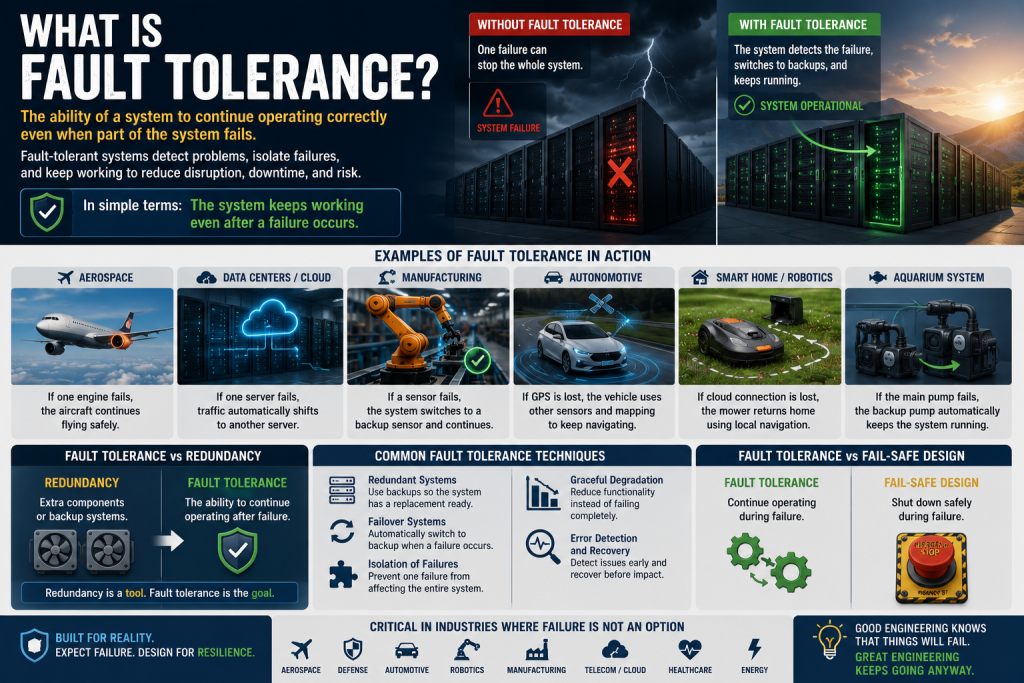
Fault tolerance is the ability of a system to continue operating correctly even when part of the system fails.
In engineering and technology, fault-tolerant systems are designed to:
- detect problems,
- isolate failures,
- continue functioning,
- and reduce disruption or danger when something goes wrong.
In simple terms:
Fault tolerance means the system keeps working even after a failure occurs.
Why Fault Tolerance Matters
No system is perfect.
Components eventually fail because of:
- wear,
- heat,
- vibration,
- software bugs,
- power interruptions,
- sensor failures,
- network outages,
- or unexpected environmental conditions.
Fault tolerance helps prevent:
- complete shutdowns,
- dangerous failures,
- downtime,
- data loss,
- and cascading system problems.
In critical industries, fault tolerance can save:
- money,
- equipment,
- missions,
- and lives.
Simple Examples of Fault Tolerance
Aerospace Example
A commercial aircraft loses one engine but continues flying safely using the remaining engine systems.
That is fault tolerance.
Data Center Example
If one server fails, traffic automatically shifts to another server without interrupting service.
That is fault tolerance.
Manufacturing Example
A factory robot detects a faulty sensor and switches to a backup sensor while continuing production.
That is fault tolerance.
Automotive Example
An autonomous vehicle temporarily loses GPS signal but continues navigating using cameras, radar, and onboard mapping systems.
That is fault tolerance.
Smart Home Example
A robotic lawn mower loses connection to cloud services but still safely returns to its charging station using local navigation memory.
That is fault tolerance.
Aquarium Example
An aquarium life-support system automatically switches to backup pumps after detecting a primary pump failure.
That is fault tolerance.
An octopus escaping because someone forgot to latch the maintenance hatch?
That is something else entirely.
Fault Tolerance vs. Redundancy
These terms are closely related but not identical.
| Term | Meaning |
|---|---|
| Redundancy | Extra components or backup systems |
| Fault Tolerance | The ability to continue operating after failure |
Redundancy is often used to achieve fault tolerance.
Example:
- two backup power supplies,
- multiple sensors,
- duplicate network paths,
- or secondary hydraulic systems.
However, simply adding extra parts does not automatically create a fault-tolerant system.
The system must also:
- detect failures,
- switch correctly,
- and continue operating safely.
Common Fault Tolerance Techniques
Engineers use many strategies to improve fault tolerance.
Redundant Systems
Using backup components or duplicate systems.
Examples:
- backup generators,
- multiple flight computers,
- secondary braking systems.
Graceful Degradation
Reducing functionality instead of failing completely.
Example:
A vehicle limiting speed after sensor degradation rather than shutting down instantly.
Failover Systems
Automatically switching to backup hardware or software after a failure.
Example:
Cloud platforms moving workloads to another server cluster.
Error Detection and Recovery
Identifying faults and correcting them before failure spreads.
Examples:
- checksum validation,
- sensor diagnostics,
- AI anomaly detection.
Isolation of Failures
Preventing one failure from damaging the entire system.
Example:
Electrical circuit breakers isolating damaged circuits.
Fault Tolerance in AI and Autonomous Systems
Modern autonomous systems rely heavily on fault tolerance because they operate in unpredictable environments.
Examples include:
- self-driving vehicles,
- industrial robots,
- drones,
- smart factories,
- and autonomous lawn equipment.
These systems must handle:
- sensor failures,
- network interruptions,
- unexpected environmental conditions,
- and software errors.
This is why modern engineering increasingly combines:
- simulation,
- edge-case testing,
- digital twins,
- and real-world operational monitoring.
Can Digital Twins Improve Fault Tolerance?
Yes — digital twins are becoming important tools for improving system resilience.
A digital twin can help engineers:
- simulate component failures,
- test backup system behavior,
- identify weak points,
- model cascading failures,
- and evaluate recovery strategies before real-world deployment.
This allows organizations to improve:
- uptime,
- reliability,
- safety,
- and maintenance planning.
Industries That Depend on Fault Tolerance
Fault tolerance is especially important in:
- aerospace,
- defense,
- automotive,
- robotics,
- telecommunications,
- manufacturing,
- cloud computing,
- healthcare,
- industrial automation,
- and energy systems.
In these industries, a single failure may have serious consequences.
Fault Tolerance vs. Fail-Safe Design
These concepts are related but different.
| Concept | Goal |
|---|---|
| Fault Tolerance | Continue operating during failure |
| Fail-Safe Design | Shut down safely during failure |
Example:
- A passenger aircraft uses fault tolerance.
- An industrial emergency stop system uses fail-safe design.
Many modern systems use both approaches together.
Related Glossary Terms
- What Is an Edge Case?
- What Is a Failure Mode?
- What Is Redundancy?
- What Is Robust Design?
- What Is Design Validation?
- What Is Adversarial Testing?
- What Is a Digital Twin?
- What Is Simulation Fidelity?
Final Thought
Weak systems fail when something goes wrong.
Fault-tolerant systems expect failure — and prepare for it.